The contemporary corporate ecosystem within the United Kingdom represents one of the most highly digitised and heavily regulated environments globally, with the capital city serving as a primary nexus for financial, legal, and technological enterprises. Within this densely populated commercial landscape, the management of end-of-life technology has evolved far beyond the traditional paradigms of basic waste removal. It is now universally recognised by enterprise leadership as a critical pillar of corporate governance, cybersecurity risk management, and environmental stewardship. When organisations embark on infrastructure upgrades, decommission legacy data centres, or transition to sophisticated cloud-based architectures, a fundamental and legally binding question arises regarding the ultimate fate of their retired physical assets. The processes surrounding IT equipment disposal in London are no longer optional administrative tasks relegated to facilities management; rather, they are rigorous compliance mandates governed by an intricate and intersecting web of stringent data protection laws and environmental directives.
The operational, legal, and financial stakes associated with improper IT Asset Disposition (ITAD) have never been higher. A single hard disk drive, solid-state drive, or magnetic backup tape discarded without certified, irretrievable sanitisation possesses the latent potential to trigger catastrophic corporate data breaches. Such security failures invariably result in severe reputational damage, the permanent erosion of client trust, and astronomical regulatory penalties levied by statutory bodies such as the Information Commissioner’s Office. Simultaneously, the environmental implications of electronic waste demand immediate, auditable corporate action, as the United Kingdom currently generates over 1.6 million tonnes of electronic waste annually. Decommissioned devices contain a complex matrix of hazardous materials, including lead, mercury, beryllium, and cadmium, which pose severe ecological and human health risks if permitted to leach into soil and subterranean water systems through unregulated landfill disposal.
Conversely, these obsolete devices also house valuable critical raw materials, including copper, lithium, gold, and palladium, which are essential for future manufacturing. Certified ITAD providers, such as XRecycling, operate precisely at the intersection of digital security and environmental sustainability. By offering fully compliant electronic waste recycling, military-grade data destruction, and comprehensive clearance logistics under a single operational banner, the necessity for businesses to procure and manage multiple specialised contractors is effectively eliminated. This exhaustive analysis details the modern IT disposal landscape, encompassing complex regulatory frameworks, advanced data destruction methodologies, competitive market dynamics, and the sophisticated logistical solutions necessary for hassle-free collection in the capital.
The Evolving Regulatory Architecture Governing IT Disposal
The regulatory landscape governing IT asset disposal and data protection in the United Kingdom is characterised by increasing complexity and aggressive statutory enforcement. Ignorance of these evolving legislative frameworks is not a viable legal defence. Businesses must partner with ITAD providers possessing deep regulatory fluency to avoid catastrophic fines and severe operational disruptions.
The Waste Electrical and Electronic Equipment (WEEE) Directive
The Waste Electrical and Electronic Equipment Regulations 2013, which underwent substantial and expansive amendments entering into force in August 2025 and continuing into 2026, form the absolute bedrock of electronic waste law in the jurisdiction. The fundamental objective of this directive is to systematically minimise the volume of electronic waste sent to landfill or incineration by enforcing the doctrine of Extended Producer Responsibility. Business producers of electronic waste are legally mandated to segregate their redundant technology from standard commercial waste streams, store it securely to prevent environmental contamination or data theft, and arrange for its dedicated collection and processing through licensed waste management channels.
The 2026 regulatory framework places heightened scrutiny on the corporate duty of care, demanding an unbroken chain of custody from the point of origin to the final processing facility. Only an Environment Agency-approved Authorised Treatment Facility is legally permitted to treat electronic waste through advanced shredding, material recovery, and complex disassembly. Upon completion of the processing, the facility issues an Evidence Note, frequently integrated with a digital Waste Transfer Note, which a commercial entity must retain as absolute, auditable proof that they have executed their duty of care and dealt with their electronic waste responsibly. The integration of mandatory Digital Waste Tracking, fully implemented by late 2025 and early 2026, phases out traditional paper-based transfer notes in favour of real-time digital logging, ensuring that the movement of every server, laptop, and monitor is transparently recorded.
Data Protection: UK GDPR, DPA 2018, and DUAA 2026
Parallel to environmental mandates, the UK General Data Protection Regulation and the Data Protection Act 2018 dictate the uncompromising handling of personal and corporate data residing on redundant storage media. Furthermore, the introduction of the Data (Use and Access) Act 2026 has intensified the statutory requirements for verifiable document and digital destruction across all commercial sectors. Under these comprehensive frameworks, organisations remain legally responsible for personal data as the designated Data Controller, even when utilising third-party Data Processors for logistical IT disposal.
Failing to secure a documented chain of custody, or utilising unverified, uncertified scrap merchants, exposes businesses to severe regulatory penalties capable of reaching £17.5 million or four percent of global annual turnover, whichever is greater. Compliant ITAD processes necessitate transparent, item-level reporting and the implementation of appropriate technical and organisational measures to safeguard highly sensitive data until its verified, irreversible destruction. Standard file deletion or formatting is entirely insufficient, as it leaves residual data intact on the storage media, vulnerable to extraction by basic forensic recovery software.
Fire Safety Compliance and Lithium-Ion Battery Extraction
A critical operational shift introduced by the 2025 and 2026 WEEE amendments is the intense, specific focus on fire safety regarding the processing of embedded lithium-ion batteries. The surging deployment of ultra-thin laptops, enterprise tablets, mobile devices, and commercial power tools has made these high-density batteries a prominent compliance and safety risk across the waste management sector. If inadvertently crushed in standard municipal waste compactors or subjected to unspecialised industrial shredding, damaged lithium-ion batteries present severe, explosive fire hazards through thermal runaway a phenomenon of chain exothermic reactions within the battery cells that causes a sharp, uncontrollable rise in temperature.
To mitigate this escalating risk, professional clearance teams and ITAD providers are now required to employ highly trained personnel to manually identify and meticulously extract embedded lithium-ion batteries from the primary hardware chassis prior to any mechanical crushing or material recycling. This careful, highly regulated extraction ensures that the entire disposal chain remains fully compliant, structurally safe, and continuously operational. Businesses must ensure their chosen disposal partner operates specialized, fire-safe containment systems to manage this specific hazardous waste stream.
The Strategic Framework of IT Asset Disposition (ITAD)
IT Asset Disposition represents a highly structured, secure, and environmentally responsible methodology for managing obsolete or end-of-life information technology equipment. It encompasses the complete, regulated lifecycle from the exact moment a corporate device is decommissioned, including complex secure logistics, certified data erasure, physical hardware destruction, financial value recovery through resale, and ecologically compliant, zero-landfill material recycling. Unlike basic commercial waste removal, which focuses purely on volume clearance, ITAD is a holistic risk management and value recovery strategy.
The Circular Economy and Zero-Landfill Policies
The traditional linear economic model of “take, make, and dispose” has been rendered entirely obsolete within modern technology management. Contemporary IT recycling operates strictly within a circular economy framework aimed at maximizing the usable lifecycle of enterprise hardware and recovering finite natural resources. Certified ITAD providers facilitate this circular model by prioritizing the forensic data sanitization and secure resale of refurbished equipment, ensuring an absolute zero-landfill policy. When hardware retains functional utility, extending its lifespan significantly reduces the demand for raw material extraction, cuts down on deep ore mining, and drastically lowers the global carbon footprint associated with manufacturing new electronics.
For enterprise hardware that has suffered catastrophic failure or cannot be economically repaired, the operational focus shifts to ethical material recovery. Decommissioned devices are systematically dismantled, and components are processed through advanced optical, magnetic, and eddy-current separators to isolate ferrous metals, non-ferrous metals, complex plastics, and precious elements. Every device recycled responsibly through an Authorised Treatment Facility helps prevent toxic chemical release into vulnerable ecosystems while recovering critical materials required to sustain global supply chains.
Financial Value Recovery and Asset Rebates
Retired IT equipment frequently holds untapped financial value, particularly within enterprise-grade infrastructure deployments. Advanced ITAD providers not only recycle safely but also actively recover maximum financial value from decommissioned assets, helping commercial businesses offset the substantial capital expenditures associated with technology refresh cycles. High-value enterprise assets, such as recent-generation servers, core networking switches, and modern corporate laptops, can yield significant financial rebates. Through transparent auditing, technical testing, and cosmetic grading processes, businesses receive an itemized valuation of their redundant hardware, transforming a historical cost center into a mechanism for revenue generation.
Corporate ESG Alignment and Charitable Donations
Environmental, Social, and Governance strategies are now core business priorities for organizations operating in the capital. Forward-thinking companies demand sustainable asset disposition solutions that provide transparent reporting for sustainability metrics, including detailed carbon offset calculations and landfill diversion statistics. Furthermore, ITAD providers facilitate the generation of measurable social value by coordinating the donation of securely sanitized, refurbished computers to charitable causes, schools, and digital inclusion initiatives. This ensures that redundant corporate technology benefits disadvantaged communities, directly supporting the social and environmental pillars of corporate ESG frameworks.
Technical Methodologies for Certified Data Destruction
The absolute, irreversible eradication of highly sensitive proprietary data residing on decommissioned hardware is the foundational imperative of any secure computer recycling service. The ongoing debate surrounding the efficacy of various destruction methods highlights the necessity of aligning the sanitization protocol with the specific storage medium and the organization’s unique risk tolerance profile.
Cryptographic Software Erasure (NIST 800-88)
For IT assets that retain residual financial value and are slated for refurbishment, charitable donation, or corporate redeployment, certified software-based data erasure is the mandatory sanitization methodology. Utilizing industry-leading, government-approved software algorithms, data wiping processes systematically overwrite every accessible sector, hidden partition, and host-protected area of a storage drive with randomized binary code. This highly auditable methodology aligns directly with the stringent NIST SP 800-88 Rev.1 and IEEE 2883 standards.
The erasure process is forensically verified at the sector level, ensuring that the drive is functionally sanitized and immune to data recovery attempts, while the physical hardware remains intact for environmentally sustainable reuse. Software erasure is uniquely suited to modern Solid-State Drives, utilizing manufacturer-specific secure-erase protocols to navigate the complexities of flash memory wear-leveling algorithms.
Physical Hard Drive and Media Shredding
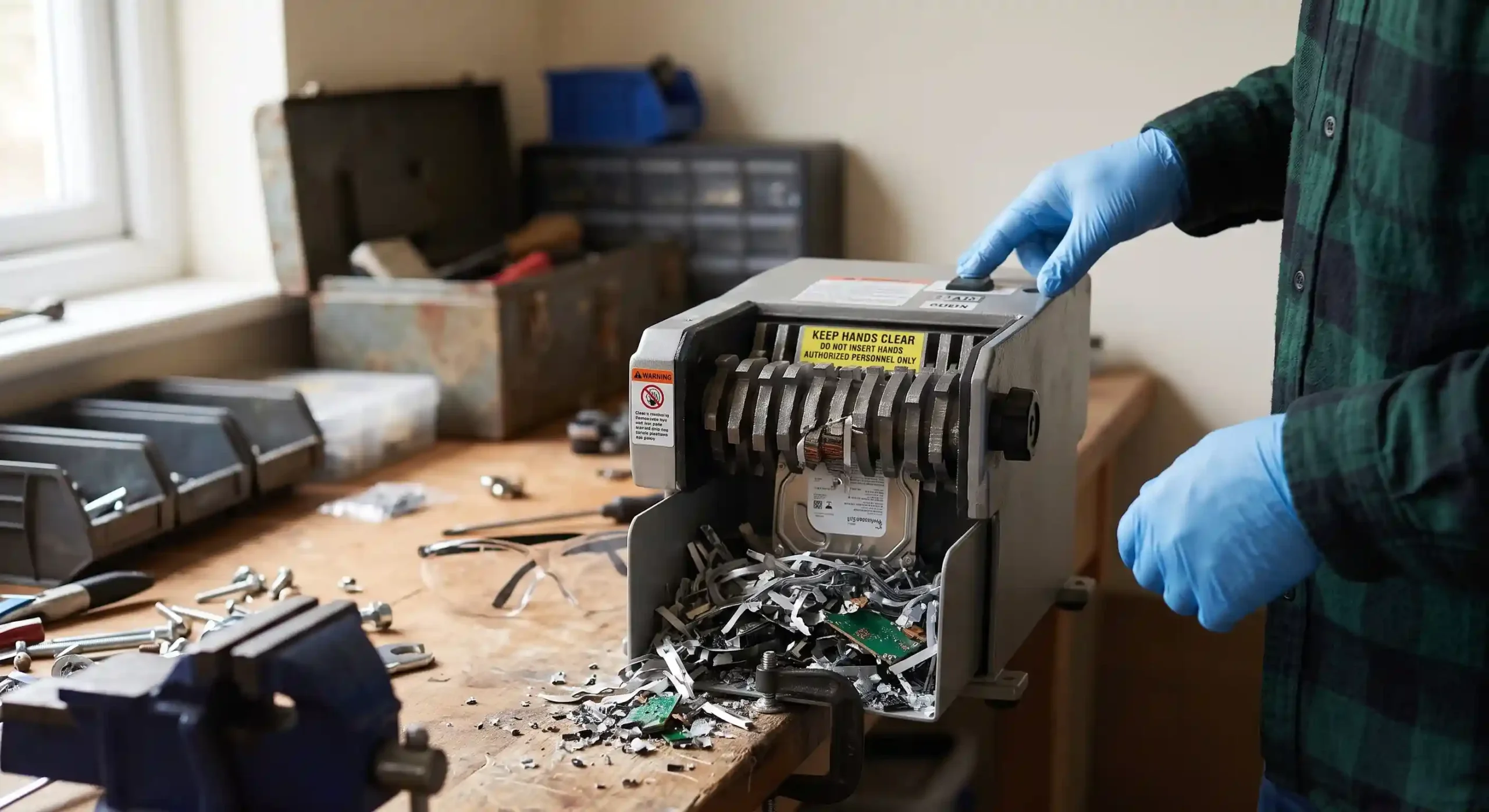
When storage media reaches its absolute end-of-life, is physically damaged, or when organizational policy mandates maximum security, physical hard drive shredding provides unequivocal protection. Physical shredding relies on heavy industrial machinery to pulverize storage devices into microscopic fragments, ensuring absolute physical destruction and rendering the media entirely irretrievable. Shredding is highly versatile, applicable to traditional Hard Disk Drives, Solid-State Drives, USB flash drives, optical media, and smart cards. The particle size generated by the shredding apparatus typically ranging from 6mm to 20mm—must be carefully calibrated to match the media type and the required security threshold, particularly for high-density flash memory chips which require extremely fine pulverization.
Magnetic Degaussing
Degaussing represents a highly specialized destruction technique that utilizes intense, high-powered electromagnetic fields to instantly scramble and neutralize the magnetic domains on legacy storage media. This process alters the fundamental state of the storage drive without changing its outward physical appearance, rendering the data entirely unrecoverable and the drive permanently inoperable. While highly effective for magnetic Hard Disk Drives and legacy backup tapes, degaussing is scientifically ineffective against flash-based Solid-State Drives, which store data in integrated circuits rather than on magnetic platters. Consequently, degaussing must be carefully paired with secondary physical destruction methods when processing mixed batches of modern enterprise media.
Forensic Auditing and the Certificate of Destruction
Absolute certainty in data security is achieved exclusively through meticulous forensic documentation and verifiable administrative processes. A certified IT disposal service must issue a comprehensive, legally recognized Certificate of Destruction for every single data-bearing device processed. This critical legal document must explicitly correlate the specific, scanned serial number of the hardware with the precise destruction method utilized, bearing the timestamp and the signature of the authorized, security-vetted technician who performed the sanitization. Coupled with detailed asset inventories and erasure audit logs, this documentation creates an impenetrable chain of custody that easily satisfies Environment Agency audits, ICO inquiries, and internal corporate compliance reporting requirements.
| Destruction Methodology | Mechanism of Action | Applicable IT Media | Optimal Strategic Use Case |
| Certified Software Erasure | Cryptographic sector overwriting to NIST 800-88 standards | HDDs, SSDs, Enterprise Servers, Active Mobile Devices | Assets retaining high residual financial value for refurbishment |
| Magnetic Degaussing | High-intensity electromagnetic field disruption | Magnetic HDDs, Legacy Backup Tapes, Floppy Disks | Rapid, high-volume sanitization of legacy magnetic storage |
| Physical Industrial Shredding | Mechanical pulverization to 6mm-20mm particulate fragments | HDDs, SSDs, USB Flash Drives, Optical Media, Smart Cards | End-of-life assets; strict maximum security corporate mandates |
| Drive Punching/Crushing | High-pressure kinetic piercing of memory platters or chips | HDDs, SSDs | Rapid on-site physical incapacitation prior to transport |
Processing Hardware Categories in the Corporate Environment
The modern commercial workspace utilizes a vast and highly specialized array of interconnected devices. A certified IT equipment disposal strategy must possess the technical infrastructure to process diverse hardware categories appropriately, recognizing that a desktop computer requires a vastly different handling protocol than a heavily integrated enterprise server array.
Desktop Computers, Workstations, and Laptops
Desktop computers, high-performance workstations, and corporate laptops form the foundational infrastructure of most London-based enterprises. The disposal of these units involves careful cataloging of chassis serial numbers, followed by the extraction of internal data-bearing drives for immediate sanitization. For laptops, particular attention is paid to the safe removal of swollen or degraded lithium-ion batteries. Once the data risk is neutralized, the remaining components including motherboards, processors, and cooling apparatus are dismantled to separate valuable metals from plastic housings, ensuring maximum material recovery.
Enterprise Servers and Data Centre Infrastructure
For businesses operating within finance hubs or managing extensive cloud architectures, data centre decommissioning is a highly technical, high-stakes logistical operation. Outdated enterprise servers, vast RAID storage arrays, core network switches, and heavy Uninterruptible Power Supply (UPS) systems must be systematically de-racked and cleared. This process requires specialized extraction protocols to ensure absolute operational continuity for adjacent, active network segments. Processing these robust machines must account for their high embodied energy footprint, necessitating precise material recovery to offset initial manufacturing carbon costs and specialized handling of highly sensitive, dense server storage media.
Mobile Devices, Tablets, and Telephony
The proliferation of mobile technology has exponentially increased the deployment of corporate smartphones and tablets. These devices present unique security risks due to their extreme portability, built-in cloud synchronization, and the high concentration of proprietary communication data they hold. Secure disposal requires the systematic removal of Mobile Device Management (MDM) locks, iCloud accounts, and physical SIM/SD cards. Following administrative unlocking, devices undergo manufacturer-specific secure-reset procedures, which, due to default full-disk encryption on modern mobile operating systems, permanently crypto-erases the data before the device is refurbished or physically shredded.
Printers, Copiers, and Audiovisual Peripherals
Heavy-duty commercial printers, multifunctional copiers, scanners, and high-definition display monitors contain complex mixtures of recyclable plastics, glass, and hazardous chemical toners. Modern enterprise copiers often contain internal hard drives that cache every scanned or printed document; these embedded drives require immediate localized destruction prior to the recycling of the primary chassis. Furthermore, LCD and LED monitors require specialized handling within an Authorised Treatment Facility to prevent the release of hazardous microplastics and volatile organic compounds during the dismantling process.
Overcoming Urban Logistical Friction in Central London
Executing corporate IT asset disposition within Greater London requires an intricate, highly specialized understanding of the city’s unique geographical, infrastructural, and regulatory friction points. Standard logistics approaches utilized in suburban environments are vastly insufficient for the capital, requiring service providers to deploy highly adapted operational strategies.
Navigating Emission Zones and Urban Surcharges
Operating commercial freight vehicles in central London involves navigating the continuously expanding Ultra Low Emission Zone and the high-cost Congestion Charge areas. Daily transport surcharges heavily inflate the cost of basic waste removal if not proactively managed. Premier ITAD providers operate agile, Euro 6 compliant, low-emission or fully electric fleets specifically designed to operate efficiently within these restricted zones. This specialized fleet management ensures rapid deployment without incurring unexpected regulatory fines or passing hidden transport surcharges onto the corporate client.
Parking Restrictions, Red Routes, and Access
London’s historic street layouts are characterized by incredibly strict parking restrictions, including heavily enforced Red Routes monitored by Transport for London. Securing adequate, legal parking for heavy collection trucks or secure mobile shredding units is exceptionally difficult and requires advance liaison with local borough councils to secure official parking bay suspensions. Experienced clearance teams proactively manage these bureaucratic requirements, averting the risk of escalating parking fines and ensuring that the collection vehicle has immediate, legal access to the commercial premises.
Architectural Constraints and Out-of-Hours Operations
The physical architecture of London commerce defined by narrow historical access corridors, stringent building management noise regulations, and the absolute necessity to share limited freight elevator capacities in towering, multi-tenant financial skyscrapers demands military-level logistical precision. Specialized ITAD providers deploy highly trained, security-vetted personnel equipped with the tooling and expertise to handle complex urban logistics, including multi-floor asset extractions, heavy server de-racking, and the utilization of secure, tamper-evident containment crates. To minimize disruption to core business activities in high-density areas, collections are frequently scheduled with absolute flexibility, including dedicated out-of-hours, evening, or weekend deployments.
| Logistical Friction Point | Central London Specific Context | Strategic ITAD Operational Solution |
| Emission Regulations | ULEZ & Congestion Charge financial penalties | Deployment of Euro 6 compliant or fully electric low-emission vehicle fleets |
| Street Access | TfL Red Routes & stringent council parking rules | Pre-arranged council parking bay suspensions & deployment of agile 3.5t transport vehicles |
| Building Architecture | High-rise corporate towers & shared service elevators | Expert multi-floor extraction teams utilizing secure, tamper-evident transit crates |
| Business Continuity | Strict building noise rules & workflow disruption | Bespoke out-of-hours, evening, and weekend collection scheduling |
Competitive Market Analysis: Leading IT Recyclers in the UK
Choosing the right IT recycling company is a critical governance decision. With over 800 registered IT disposal companies operating across the United Kingdom, identifying providers capable of delivering secure, compliant, and environmentally responsible recycling requires rigorous due diligence. The difference between a professional, certified ITAD provider and a basic scrap merchant dictates whether an organization achieves seamless compliance or faces a catastrophic data breach. An analysis of the top-tier competitors operating within the London market reveals distinct operational specializations and target demographics.
Innovent Recycling
Innovent Recycling positions itself as a specialist for small to medium-sized enterprises (SMEs) across the United Kingdom. Operating with ISO 27001 certification and an Environment Agency T11 exemption, they focus heavily on providing accessible, free nationwide collections for organizations processing 10 or more items. Their service model emphasizes HMG Infosec Standard 5 compliant wiping and shredding, paired with highly rated customer service, making them a highly attractive option for mid-market businesses requiring straightforward, secure WEEE compliance.
Restore Technology
As the largest IT lifecycle services provider in the UK, Restore Technology operates at a massive national scale, processing over 1.5 million IT assets annually. Their vast infrastructure, expanded through strategic acquisitions, is heavily accredited, holding ISO 14001, Cyber Essentials, and NPSA-approved data destruction methods. Restore Technology is optimally suited for massive corporate IT refreshes, managing complex data centre relocations, and servicing enterprise clients who require high-volume processing capabilities and the logistical weight to handle thousands of assets simultaneously across multiple regional sites.
Bioteknik
Bioteknik provides a highly localized, deeply experienced service tailored specifically for London and the South East of England. With over two decades of operational experience, they focus on rapid, secure collections from major business districts, explicitly targeting clients in Canary Wharf, Shoreditch, and the City of London. Operating from a secure facility in Canterbury, Bioteknik combines ISO 9001 and 27001 certifications with a strong emphasis on community impact, dedicating significant resources to refurbishing and donating functional equipment to charitable causes. Their hyper-local focus allows for agile, same-day or next-day business collections in the capital.
Zero Tech Waste
Zero Tech Waste differentiates itself within the London market through an aggressive environmental proposition, operating as a 100% carbon-negative IT recycling service. For every kilogram of carbon dioxide generated during their transport and recycling operations, they demonstrably offset two kilograms. They provide free collections across all 32 London boroughs for qualifying volumes, pairing complete data erasure with an uncompromising ethical recycling stance. This unique environmental positioning makes them highly appealing to organizations with stringent, heavily audited ESG and carbon-reduction targets.
XRecycling: The Intersection of Security and Sustainability
Operating under the guiding ethos of “Where Security Meets Sustainability,” XRecycling provides a comprehensive, military-grade solution tailored specifically to the rigorous demands of highly regulated industries, including finance, healthcare, legal services, and the public sector. Rather than competing solely on raw volume transport or generalized relocations, XRecycling focuses obsessively on the critical integration of high-security IT asset disposition, certified data destruction, and sustainable commercial office clearances.
By offering fully compliant WEEE recycling, multi-layered data sanitization, and comprehensive furniture and fixture clearances under a single operational framework, they provide London businesses with a seamless, end-to-end decommissioning partner. Their deployment of security-vetted professionals, advanced barcoding for chain-of-custody tracking, and a strict zero-landfill policy ensures that corporate clients achieve absolute regulatory compliance alongside their environmental objectives.
| Provider | Core Market Focus | Key Accreditations & Differentiators | Optimal London Client Profile |
| Innovent Recycling | UK-wide SME collections | ISO 27001, T11 exemption, 4.9★ rating | Mid-market businesses requiring free, reliable collections |
| Restore Technology | Enterprise & high-volume processing | NPSA approved, 1.5M+ annual assets | Large corporations executing massive infrastructure refreshes |
| Bioteknik | London & South East localized service | 20+ years experience, Charity donation program | City & Canary Wharf firms needing agile, local response |
| Zero Tech Waste | High-level ESG compliance | 100% Carbon Negative, Double offset commitment | Organizations with strict carbon-reduction mandates |
| XRecycling | Regulated industries & full workspace decommissioning | Military-grade data destruction, Office removal integration | Finance, legal, and healthcare sectors requiring end-to-end security |
Comprehensive Office Clearance and Asset Management
In addition to dedicated IT asset processing, transitioning to a new commercial workspace or down-sizing a corporate footprint requires substantial, multifaceted logistical support. Premier providers seamlessly integrate secure IT removal with the environmentally responsible disposal of broader commercial assets.
Sustainable Office Furniture Disposal
A comprehensive office clearance extends beyond servers and monitors to include the ethical disposal of office furniture, including desks, ergonomic chairs, storage cabinets, and installed partitions. Sustainable clearance operations prioritize the integration of circular economy principles by identifying high-quality furniture for refurbishment and secondary market resale, or by facilitating donations to community projects and non-profit organizations. When items are damaged beyond repair, the materials predominantly wood, metal, and hard plastics are systematically separated and directed to specialized recycling facilities, significantly reducing the environmental impact of corporate relocations.
Confidential Paper Shredding
Despite rapid digitization, the modern corporate ecosystem still generates vast quantities of highly sensitive physical records. Confidential paper shredding is a critical operational imperative bound by the exact same severe legal and financial implications as digital data destruction. Depositing sensitive corporate paperwork into standard commercial waste streams exposes businesses to systematic identity theft and catastrophic regulatory penalties. Integrated clearance providers offer secure, locked consoles for office environments and deploy industrial cross-cut shredders to destroy physical archives, ensuring that human resources files, legal contracts, and financial ledgers are pulped and recycled in full compliance with the Data Protection Act 2018.
Frequently Asked Questions (FAQ) Regarding London IT Disposal
Why is professional IT equipment disposal legally required for London businesses?
Professional disposal ensures strict compliance with stringent UK data protection laws, specifically the UK GDPR and the Data Protection Act 2018, while simultaneously satisfying environmental mandates under the WEEE Regulations. Partnering with a certified provider eliminates the severe risk of corporate data breaches, prevents toxic electronic waste from contaminating ecosystems, and shields the organization from catastrophic regulatory fines.
What specific information is detailed on a Certificate of Destruction?
A Certificate of Destruction is a legally recognized, forensic document that provides absolute proof of data eradication. It meticulously details the specific, scanned serial numbers of the processed devices, explicitly states the precise method of destruction utilized (such as NIST 800-88 cryptographic wiping or 6mm physical shredding), records the timestamp of the operation, and bears the signature of the authorized, security-vetted technician, ensuring full audit readiness for compliance officers.
How do disposal teams handle the severe fire risks associated with modern lithium-ion batteries?
Modern IT recycling incorporates rigorous, highly specialized safety protocols for the handling of lithium-ion batteries. In strict compliance with 2025 and 2026 WEEE regulatory amendments, embedded batteries within ultra-thin laptops and mobile devices are meticulously extracted by trained personnel prior to any mechanical shredding. This manual intervention completely neutralizes the extreme risk of thermal runaway and subsequent chemical fires within waste processing facilities.
Is on-site data destruction available for high-security businesses in central London?
Yes. For financial institutions, legal firms, or government bodies requiring maximum security and visual verification, specialized mobile shredding units can be deployed directly to the corporate premises. Vetted technicians physically destroy hard drives, SSDs, and optical media on-site, providing immediate documentation before the pulverized materials are transported for ethical recycling.
What types of commercial IT hardware do certified providers collect and recycle?
Comprehensive ITAD services cover nearly the entire spectrum of corporate technology. This includes standard desktop computers, high-performance laptops, dense enterprise server arrays, network switches, routers, active mobile phones, tablets, large-format monitors, commercial printers, EPOS point-of-sale terminals, and CCTV security equipment.
Are there minimum quantity thresholds required to qualify for a secure collection?
While specialized logistics fleets operate across the capital daily, specific collection thresholds and potential fees depend heavily on the total volume, age, and residual financial value of the equipment. Bulk collections of high-value enterprise-grade hardware frequently qualify for entirely free collection or lucrative rebate structures, whereas highly specialized, low-volume, or purely destructive services typically carry specific, transparent transport and processing fees.
How do logistics teams manage collections in areas with severe parking restrictions, such as TfL Red Routes?
Experienced urban logistics teams possess a deep, practical understanding of London’s restrictive infrastructure. This includes deploying ULEZ-compliant Euro 6 vehicles, proactively pre-arranging official parking bay suspensions with local borough councils, and executing highly coordinated out-of-hours or weekend collections to navigate Congestion Zones and Red Routes legally, safely, and efficiently.
What happens to enterprise IT equipment if it is not physically shredded?
Hardware that remains functionally viable undergoes military-grade, certified software data erasure. Once cryptographically sanitized, the equipment is systematically refurbished, rigorously tested to confirm operational stability, and responsibly reintroduced into the secondary market. This advanced circular economy approach significantly extends the lifecycle of complex electronics, supports corporate ESG goals by generating social value, and ensures a strict, highly auditable zero-landfill outcome.
X Recycling Ltd
46 Jellicoe Rd, Leicester LE5 4FN
Phone: 02034757578
https://share.google/DOSkV5K1HF2dykvQ1